

 For an industry that has long been fighting declining demand — casual workplace attire, remote work, wrinkle-resistant fabrics, and rising prices that pushed routine garment care out of many household budgets — CD One Price Cleaners is making a contrarian argument: the problem isn’t that consumers stopped needing drycleaning. It’s that drycleaning stopped being affordable enough to use regularly and that the convenience of drycleaning failed to adapt with the times.
This year, the company is putting that thesis to the test with the most aggressive expansion in its history. After pausing franchise sales during the COVID-19 pandemic to refine its operating model, CD One is once again actively selling — and its first two Next-Gen markets, Milwaukee and Detroit, are the proof of concept.
CD One Price Cleaners opened its Milwaukee-area flagship production plant in West Allis this past April, followed by satellite drop-off locations across the metro area. All six Milwaukee-area stores — the West Allis plant plus satellites including Milwaukee, Brookfield, Greendale, Wauwatosa, and Kenosha — are now open and operating.
The Wisconsin buildout was a purchase-and-renovation project by a franchise owner: a 6,000-square-foot plant with retail, supported by six total stores, representing a $6.5 million investment. Every garment in the market is cleaned at the West Allis plant, while the satellite stores serve as 24/7 automated drop-off and pickup points.
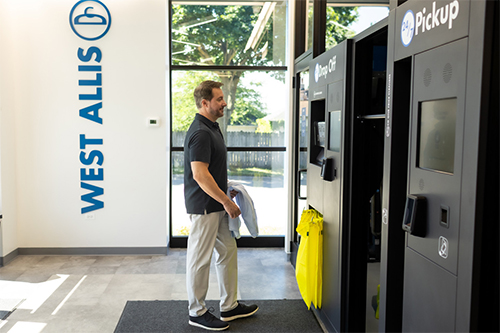 “Our company prides itself on providing exactly what today’s customers want – convenience, value, and transparency. Through our tech-forward cleaning model and automated kiosk drop-off system, we offer those benefits, and then some,” said Operations Field Consultant Michael Jackson.
The customer proposition is simple: any garment drycleaned and pressed for $3, same or next-day turnaround included, with savings of up to 70% off competitor prices. A $3 simple price point in a market where the average garment can run closer to $10 invites an obvious question: how does the margin work? The company’s answer is that the price is the output of the system, not a promotional loss leader.
CD One has always operated on a one-low-price model — in its established markets, such as Chicagoland for example where the maximum drycleaning price across their system is $5. But the Next-Gen markets add plant automation adding additional efficiencies that let the company pass additional savings to customers. The system was engineered to drive down the cost of processing each garment through centralized production, automation, standardized processes, purchasing scale, 24/7 kiosks, and higher plant utilization. The selling price is lower in dollar terms, but operating efficiencies preserve a healthy percentage margin, and higher volume and better plant utilization strengthen the return on investment.
“We’ve worked hard to meet the modern consumer’s standard for convenience, value, and transparency. By investing in cutting edge technology in both our cleaning services at our plant, and at our drop-off and pickup kiosk stores, we have figured out how to optimize efficiency, and we are delighted to pass those savings along to our customers!” said Jackson.
What makes the West Allis facility “state of the art” is not any single machine, according to the company, but the way the entire operation is connected — from garment tracking and automated order assembly to bagging, sorting, dispatch, and 24/7 customer pickup. The plant runs carousel order-picking systems, garment product tracking, automated order assembly, auto-baggers, and auto-dispatch systems, alongside Sankosha equipment including the Sankosha Press-Free Finisher.
Automation hasn’t removed people from garment care decisions, the company stresses. Garments are individually identified, tracked, inspected, and routed according to fabric, construction, stains, and care requirements. Delicate and specialty items are separated from standard production and handled accordingly — and when an item requires expertise or a process the company doesn’t provide, the store contacts the customer before processing, explains why, and recommends a specialist, so the customer isn’t surprised at pickup.
The company also runs its own custom-built customer support platform that gives customers access to a live human 24/7 by video or phone, and it uses Net Promoter Score systematically — not as a vanity metric, but to locate pain points, deploy targeted training, and fix problems at the source.
Detroit is next, and the company expects the market to open in Q4 of this year. The buildout mirrors Milwaukee’s approach, at a slightly larger scale: an 8,500-square-foot plant with retail, purchased and renovated out of a former Rite Aid store, anchoring a launch cluster of 11 total stores — a $10 million investment.
The market logic is straightforward. Detroit’s average blended cost to dry clean a garment was $9.16 as of February of this year. And Detroit fits the operating model: a large suburban population, strong retail corridors, suitable real estate, and enough density to support a central plant surrounded by satellite locations. The cluster approach builds brand awareness quickly while keeping one production facility running at high utilization.